Topic: era
72 stories found
Today
Flint: A Visualization Language for the AI Era
Flint is a new visualization language designed to enhance understanding of artificial intelligence models, addressing the need for clearer insights into complex AI systems. This tool is crucial as AI becomes more integrated into various sectors, requiring transparency and explainability in its operations.
Yesterday
Disrupting a Criminal Scam Operation
OpenAI shut down a criminal scam operation in Cambodia that utilized ChatGPT for various fraudulent schemes including investment, romance, gambling, and identity impersonation. This disruption highlights the potential of AI tools like ChatGPT to be misused for illegal activities but also showcases efforts to combat such scams.
Prompt Chaining in Practice: A Case Study in Automated Scholarly Report Generation
A study demonstrates that prompt chaining can improve the reliability and quality of automated scholarly report generation, addressing limitations of simpler prompting methods in handling complex synthesis tasks. This matters because it highlights potential advancements in automating information synthesis for the vast volume of scholarly publications.
Thursday, July 30, 2026
ggml/llama.cpp releases: b10199
The ggml/llama.cpp project released version b10199, which adds support for input embedding to generate the next token and fixes issues with server_batch(). These updates enhance the model's functionality and performance.
Do Methods Support the Claims? Intra-Paper Verification for Peer Review
A new study proposes using large language models to help verify claims within papers during the peer review process, aiming to address the increasing volume of scientific submissions. This method could enhance the accuracy of assessing a paper's originality and significance by comparing its content directly with existing literature.
Wednesday, July 29, 2026
Accelerating scientific discovery with ChatGPT for Academic Researchers
OpenAI provides 100,000 academic researchers with free access to its most advanced AI models through ChatGPT, aiming to speed up scientific research, collaboration, and discovery. This initiative is significant as it leverages AI to potentially accelerate breakthroughs across various fields of study.
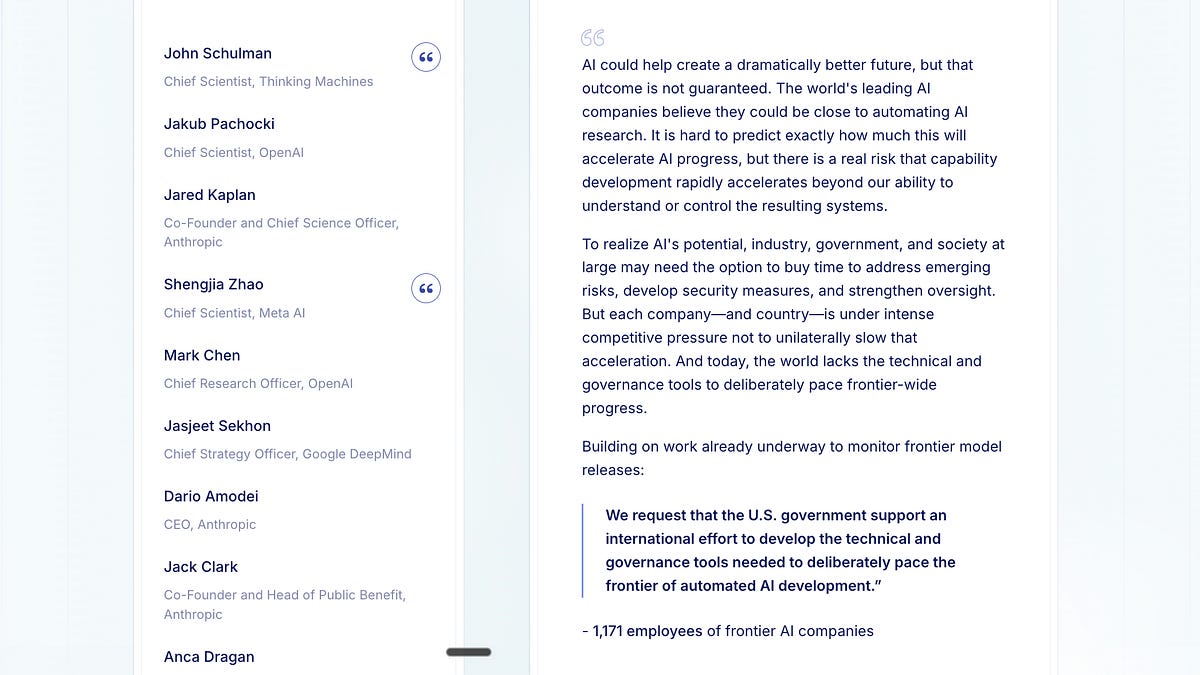
[AINews] Fearing RSI: OpenAI, Anthropic, GDM, Meta, Thinky cosign letter to "Pace" AI development, as HuggingFace details Machine-Speed Offensive Cyberattack
Tech giants including OpenAI and Anthropic have jointly signed a letter calling for a pause in AI development to address risks. Meanwhile, HuggingFace revealed it was targeted by a cyberattack aimed at slowing down progress in the field.
TimeCapsule: Generative Hallucination as a Method for Historical Sensemaking
TimeCapsule is a new method using a large language model to address the temporal bias in contemporary training data, making these models unreliable for historical contexts. The researchers developed TimeCapsule, a 1.2B-parameter model, to better handle historical sensemaking by reducing present-day concept encoding.
Tuesday, July 28, 2026
72 of 72 items shown. Sources: 73 days indexed.